Society Registration in Nagercoil: Legal Requirements, Common Mistakes and Compliance Considerations
Society Registration in Nagercoil: Process, Documents & Compliance

INTRODUCTION
Many educational initiatives, cultural organizations, resident welfare associations, charitable groups, youth forums, and social welfare bodies initially begin operations informally.
However, issues usually arise once the organization attempts to open bank accounts, receive donations, lease property, apply for grants, or establish internal governance mechanisms.
At that stage, legal recognition through society registration becomes commercially and administratively significant.
REGISTRATION GOVERNED BY – STATUTORY
While the Societies Registration Act, 1860 may continue to serve as a historical and interpretational point of reference in understanding the evolution of society law in India, the practical regulatory framework governing societies in Nagercoil and throughout Tamil Nadu is primarily controlled by the Tamil Nadu Societies Registration Act, 1975 and the administrative practices followed by the State Registration Department. Interestingly, from a practical compliance perspective, it is observed that reliance solely upon generalized central enactment references without appreciating the state specific procedural approach may occasionally create avoidable complications during scrutiny stages. For instance, it has been informally observed in certain registration proceedings that usage of broad expressions such as “whole of India” while describing the operational area of the proposed society may invite additional clarifications or verification concerns at the office level depending upon the nature, objects, and structural details of the organization.
WHAT FALLS WITHIN THE AMBIT OF SOCIETY UNDER TNSA
One of the most interesting aspects of the Tamil Nadu Societies Registration framework is that the law is not restricted only to large charitable institutions or traditional NGOs. The legislation is intentionally wide enough to accommodate several kinds of socially oriented, educational, developmental, and community driven organizations that are emerging today across Nagercoil and other parts of Tamil Nadu.
Under Section 2 of the Tamil Nadu Societies Registration Act, 1975, organizations formed for purposes relating to education, literature, science, charity, social reform, culture, sports, public health, social service, recreation, cottage industries, and similar useful objectives may seek registration under the Act.
From a practical perspective, this becomes highly relevant because many modern organizations do not operate merely as “charitable bodies” in the conventional sense. Coaching centres, cultural initiatives, resident welfare groups, youth development forums, skill training institutions, sports academies, social awareness platforms, and various community based initiatives often require a structured legal identity as they begin expanding their activities.
The framework under the Tamil Nadu Act therefore provides a flexible legal structure capable of supporting diverse organizational models depending upon their objectives and operational nature.
At the same time, practical experience shows that the registration process is not merely document submission. Authorities often examine whether the stated objects, governance structure, operational area, and supporting records genuinely align with the nature of the proposed organization. Consequently, the manner in which the society is structured and drafted at the initial stage may significantly influence future compliance and operational stability.
BASIC ESSENTIALS TO LEGALLY CONSTITUTE A SOCIETY
- Should be constituted for a promotion of legal activities, diffusion of useful knowledge and such other useful object – and all of these should fall within the legislative power of the state [ kindly refer Seventh Schedule of Indian Constitution’s State list for further information].
- Should not be constituted with the object of improving economic condition.
- Should not be constituted for the purpose of offering opportunity to play games of chance and provide prices for winners.
- Should be minimum of seven persons.
WHAT ATTRACTS COMPPLUSORY REGISTRATION?
1. Every society operating from or after 25th August 1975, which has lawful objects [ for promotion of lawful activities, for diffusion of useful knowledge and useful objects as per State List]
Note: These lawful objects and activities for compulsory registration does not include promotion of religion/athletics/ sports.
a) Consisting of 20 members or more
b) With annual gross income / expenditure of Rs.10,000/- or more from the date of commencement of operation of the society
2. Every society actively in existence on or before 25th August 1975, which has lawful objects [ for promotion of lawful activities, for diffusion of useful knowledge and useful objects as per State List] and not registered under the central act [Societies Registration Act,1860] or any other corresponding act before 25th August 1975
Note: These lawful objects and activities for compulsory registration does not include promotion of religion/athletics/ sports.
a) Consisting of 20 members or more
b) With annual gross income / expenditure of Rs.10,000/- or more from the date of commencement of operation of the society
c) With gross income / expenditure for the preceding financial year from the date of commencement of operation of Rs.10,000/- [ statutory limit for 12 months] and
Note : If operated for less than 12 months till the date of commencement to be proportionately calculated with statutory limit of Rs.10,000/- - if it does not reach the statutory limit of Rs.10,000 – law does not mandate registration
If a society registered / formed / incorporated under any other corresponding act – compulsory registration under this act is not mandated
WHICH AUTHORITY GRANTS SOCIETY REGISTRATION IN NAGERCOIL?
Under the Tamil Nadu Societies Registration framework, the primary authority responsible for examining and granting registration is the jurisdictional District Registrar functioning under the Registration Department of the Government of Tamil Nadu. Since society registration is administered through the territorial jurisdiction framework of the Registration Department, identifying the appropriate registration authority becomes an important preliminary step before initiating the filing process.
The following is the list of District Registration Offices in Kanyakumari :-
| S.No | Name of the Office | Address |
| 1. | District Registrar, Nagercoil | Backside of S.L.B.Girls Government High School, Near, South Road, Nagercoil, Tamil Nadu 629001 |
| 2. | District Registrar, Marthandam | Marthandam, Kanyakumari, NH – 47,Salem Kochi Kanyakumari Highway, Tamil Nadu 629165 |
UNDERSTANDING THE REGISTRATION PROCESS IN PRACTICAL TERMS :-
STEP 1 - PREPARATION OF CONSTITUTIONAL DOCUMENTS AND INTERNAL GOVERNANCE STRUCTURE
One of the initial and most important stages in the society registration process involves preparation of the memorandum and other foundational constitutional documents governing the proposed organization.
Although pre - defined formats and model bylaws are generally available through the online registration framework [TNREGINET], many organizations prefer restructuring these documents in accordance with their actual objectives, governance model, operational structure, and intended activities.
A. MEMORANDUM
From a practical perspective, the memorandum generally contains particulars relating to:
a) Name of the proposed society
b) Registered office address
c) Objects and intended activities of the organization
d) Details of the beneficiaries or target group
e) Particulars of the founding members
f) Designations of office bearers such as President, Secretary, Treasurer, and Executive Committee members
g) Name, address, occupation, and signature details of the concerned member
h) Execution formalities involving signatures and witness
Authentication
At the drafting stage itself, organizations also generally finalize the internal governance structure and the designations of persons proposed to administer the society. This commonly includes positions such as President, Vice President, Secretary, Treasurer, and other Executive Committee members depending upon the administrative structure of the proposed organization.
This stage becomes practically significant because the memorandum, filing forms, member tables, declarations, and supporting records generally require details relating to the designation, address, occupation, and signatures of the concerned members and office bearers.
Practical Insight 1:
“ While drafting the objects clause of the proposed society, it is generally advisable to ensure that the nature of activities, intended beneficiaries, and the mode through which such activities are proposed to be implemented are described with reasonable specificity. Similarly, where the proposed organization is intended for the welfare or development of a particular category of persons, aligning the name of the society with the intended beneficiary group may assist in establishing greater organizational clarity during scrutiny stages. For instance, in the case of an organization proposed for the welfare of nurses, usage of a name such as “Nurses Welfare Society” together with corresponding object clauses may help avoid practical queries relating to identification of the intended beneficiaries.
Practical Insight 2:
“While finalizing the registered office address of the proposed society, it is generally advisable to identify the appropriate jurisdictional registration authority based on territorial jurisdiction before initiating the filing process.”
B. RULES AND REGULATIONS
In addition to the memorandum, the proposed society is also generally required to prepare a detailed set of rules and regulations governing the internal functioning and administration of the organization.
Although model structures are commonly available through the registration portal, it is often advisable to retain the broad structural flow contemplated under the standard framework while suitably aligning the clauses with the actual name, address, governance structure, operational activities, and administrative requirements of the proposed society.
From a practical governance perspective, the rules and regulations generally address matters relating to:
a) Name and registered office of the society
b) Organizational objectives and activities
c) Admission, rights, obligations, removal, and appeal
d) mechanism relating to members
e) Subscription fees and financial administration
f) Constitution, powers, and duration of the Executive Committee
g) Duties and responsibilities of office bearers
h) Authority relating to legal proceedings including persons authorized to sue or defend proceedings on behalf
of the society
i) Maintenance of accounts, audit procedures, and balance sheet preparation
j) Conduct of Annual General Meetings and Extraordinary General Meetings
k) Election procedures for office bearers and Executive Committee members
l) Procedure relating to special resolutions
m) Maintenance and inspection of statutory records, registers, minutes books, and books of account at the registered office of the society
C. STATUTORY FORMS AND SUPPORTING GOVERNANCE RECORDS
Apart from the memorandum and the rules and regulations, the registration process also generally involves preparation and submission of certain statutory forms and supporting governance records prescribed under the Tamil Nadu Societies Registration framework.
From a practical filing perspective, some of the commonly used forms and supporting records include:
a) Form No. 1 – Application for issuance of Certificate of Registration under Section 10 of the Tamil Nadu Societies Registration Act, 1975
b) Form No. 5 – Notice relating to the situation of the registered office of the society under Section 13(1) of the Tamil Nadu Societies Registration Act, 1975
c) Form No. 6 – Statement relating to the members of the Governing Body of the society
Practical Insight 3:
“One of the commonly overlooked aspects during the registration process involves maintaining consistency across the memorandum, rules and regulations, statutory forms, and meeting resolutions. Variations in names, designations, addresses, objectives, or governing body details across documents may occasionally result in clarification requirements during scrutiny stages.
STEP 2- ONLINE FILING PROCEDURE THROUGH TNREGINET PORTAL
Following preparation of the constitutional documents, statutory forms, and governance records, the registration process generally proceeds through the TNREGINET online filing framework administered by the Registration Department of the Government of Tamil Nadu.
From a practical perspective, the online filing stage primarily involves:
a) creation of the society profile
b) submission of organizational particulars
c) uploading of member and witness detail
d) generation of statutory records
e) payment of prescribed fees
f) tracking of the application status through the portal interface.
Practical Insight 4:
“One important procedural aspect often overlooked during the initial stage is that society registration on the TNREGINET framework generally requires creation of a separate user profile specifically intended for society registration related services. In practical operation, the same account may not always provide access to other categories of registration services available through the TNREGINET portal.”
I. Member, Witness, and Governance Particulars
The filing process generally begins with user registration and login through the TNREGINET portal, following which the applicant may proceed to the society registration module and initiate the application for registration of the proposed organization.
At the preliminary stage, the portal generally requires entry of foundational organizational particulars including the proposed name of the society, date of formation, registered office details, territorial particulars, and contact information relating to the organization.
The filing framework also ordinarily requires disclosure of the principal objectives of the proposed society, organizational category details, financial year particulars, and annual governance related particulars such as the AGM due date.
The online filing stage further involves submission of details relating to executive and non executive members, their respective designations, enrolment particulars, identity details, address particulars, occupation details, and supporting governance information through the prescribed portal interface.
The portal framework also generally requires entry of witness particulars, supporting address details, and verification related information before proceeding to the next stage of filing.
Practical Insight 5:
“During the online filing stage, maintaining consistency between the memorandum, rules and regulations, statutory forms, member particulars, and portal entries becomes extremely important. Even minor inconsistencies in names, designations, addresses, or object clauses may result in clarification requirements during scrutiny stages.”
II. Portal Based Bylaw Integration and Verification
The TNREGINET framework also provides pre defined bylaw structures capable of being modified in accordance with the operational requirements and governance structure of the proposed society. From a practical drafting perspective, organizations often prefer reviewing and aligning these clauses with their constitutional documents before final submission in order to maintain governance consistency across all records uploaded through the portal.
III. Generation of Forms, Fee Payment, and Submission
Upon completion of the data entry and verification stages, the portal generally enables generation of the statutory forms and filing records required for the registration process. The process thereafter ordinarily proceeds through the electronic payment framework involving verification of applicant particulars, selection of office details, online payment processing, banking confirmation, and submission of the prescribed registration fees through the TNREGINET payment interface.
IV. Application Tracking and Download
Following submission of the application, the applicant may generally track the status of the registration through the society registration search and status tracking modules available within the TNREGINET framework. The portal also ordinarily enables generation, downloading, and printing of the application and related registration records upon successful creation and processing of the filing request.
Society Registration in Nagercoil – Quick Checklist
- Confirm eligibility of the proposed society and its intended objects.
- Finalise the society's name and registered office address.
- Identify the required founding members and proposed office bearers.
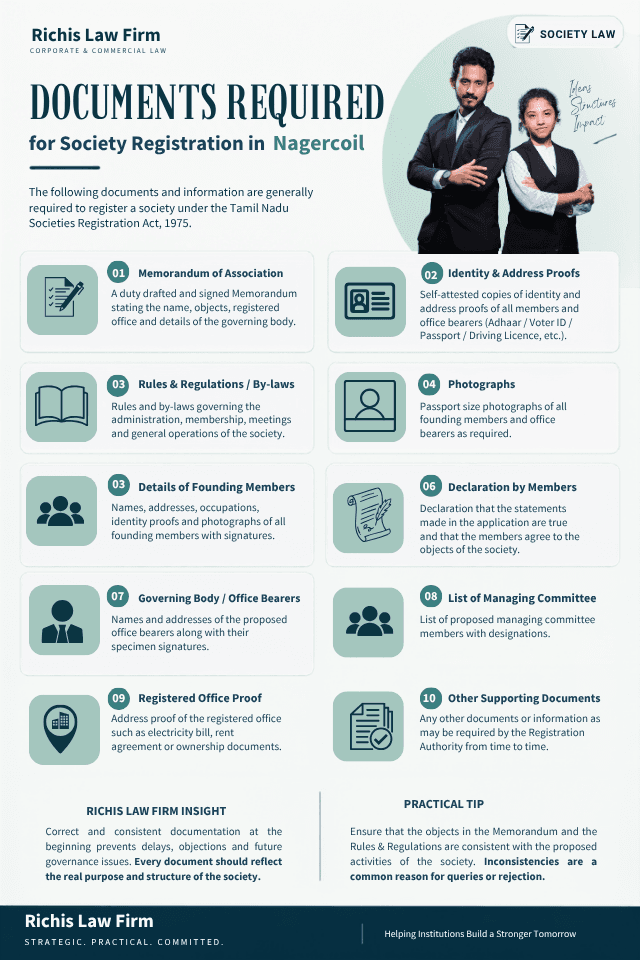
- Prepare the Memorandum of Association with clearly defined objects and member particulars.
- Draft the Rules & Regulations / By-laws governing membership, meetings, administration and finances
- Collect identity, address, photograph and registered-office proofs of the required persons
- Complete the prescribed forms and online filing through the applicable registration mechanism.
- Verify consistency between the Memorandum, By-laws, member details and application before submission
- Pay the prescribed registration fee and retain the filing acknowledgement.
Monitor the application and respond promptly to any objection, deficiency or query raised by the registering authority.
CONCLUSION
Society registration in Tamil Nadu extends beyond mere procedural filing and substantially involves governance structuring, drafting clarity, compliance alignment, and institutional planning from the very initial stage. From preparation of constitutional documents and identification of jurisdictional authorities to online filing through the TNREGINET framework, each stage plays an important role in determining the future operational and administrative stability of the proposed society. Accordingly, careful structuring of the organization at the time of registration may significantly assist in reducing avoidable compliance, governance, and procedural difficulties in the long run.
Continue Reading
Frequently Asked Questions
How do I register a society in Nagercoil?
Society registration in Nagercoil is carried out before the jurisdictional District Registrar under the Tamil Nadu Societies Registration Act, 1975. The process generally involves preparing the memorandum, rules and regulations, statutory forms, and filing the application through the TNREGINET portal.
Which authority registers societies in Nagercoil?
The jurisdictional District Registrar under the Registration Department, Government of Tamil Nadu, processes society registration applications depending on the registered office location.
What documents are required for society registration in Nagercoil?
Commonly required documents include the Memorandum of Association, Rules and Regulations, details of the governing body, registered office proof, identity and address proof of members, prescribed statutory forms, and other supporting documents required under the Tamil Nadu Societies Registration Act, 1975
How many members are required to register a society in Tamil Nadu?
A minimum of seven persons is generally required to form a society under the Tamil Nadu Societies Registration Act, 1975, subject to compliance with the applicable legal requirements.
Is society registration mandatory in Tamil Nadu?
Registration is not mandatory for every informal group. However, depending on the nature of the organization, membership, income, expenditure, and statutory requirements under the Tamil Nadu Societies Registration Act, registration may become compulsory.
Can a registered society open a bank account?
Yes. A registered society can generally open a bank account, subject to the bank's documentation requirements and applicable regulatory procedures.
Can a society operate outside Nagercoil?
The operational scope of a society depends upon its objects, constitutional documents, and applicable legal requirements. Practical scrutiny may also vary based on the proposed activities.
Disclaimer
This article is for general information only and does not constitute legal advice or create an advocate-client relationship. Statutes, rules, rates and compliance requirements change over time and vary by circumstance.
RICHIS LAW FIRM — Strategic Business Legal Advisors.
Safeguarding business interests and enabling growth across Tamil Nadu.
Richis Jesvanth J
B.Com., LL.B., LL.M. (Corporate & Commercial Law), CS Finalist
Practising in Company Law
Pavyaa Angelina K
B.B.A., LL.B.
Practising in Taxation Law