Play School Registration in Tamil Nadu: A Complete Legal Guide for Founders
Planning to start a play school in Tamil Nadu? Learn about land, building requirements, Fire NOC, stability certificate, sanitary certificate, Public Building Licence, lease requirements, recognition, timelines and common mistakes.
.webp)
Prefer to Listen?
Listen to a concise legal briefing on play school legal compliance, regulatory requirements and due diligence considerations for school owners in Tamil Nadu.
Play School Registration in Tamil Nadu: A Complete Legal Guide for Founders
Planning to start a play school in Tamil Nadu? Before you choose a building, sign a lease or spend money on interiors, understand the legal and regulatory requirements that govern the establishment and recognition of a play school.
Starting a play school is often approached as a relatively simple business proposition: find a suitable property, create an attractive learning environment, appoint teachers and begin admissions.
The legal position is more structured.
Under the Tamil Nadu Private Schools (Regulation) Rules, 2023, a “Play School” includes a Kids School, Pre-Primary, Nursery, Kindergarten and Montessori school by whatever name called. The Rules therefore bring a broad range of early-childhood educational institutions within the private-school regulatory framework.
For a founder, the most important lesson is that registration or recognition is not merely a paperwork exercise.
The proposed premises, land, building, structural condition, fire safety, sanitation, building licence, lease, infrastructure, staffing and recognition process must be considered together.
And there is one practical principle that deserves emphasis from the outset:
Do not choose the property first and attempt to make it legally compliant afterwards.
The better sequence is:
This article explains that process in detail for founders across Tamil Nadu, including Chennai, Coimbatore, Madurai, Tiruchirappalli, Salem, Tiruppur, Erode, Tirunelveli, Kanyakumari, Thoothukudi, Vellore, Kancheepuram, Chengalpattu and the other districts of the State.
- What is a Play School under Tamil Nadu law?
- Is registration or recognition required?
- Permission to Establish versus Certificate of Recognition
- Who is the Competent Authority?
- The Most Important Decision: Choosing the Premises
- Why Legal Advice Should Come Before the Lease
- Minimum Land Requirement
- Building Requirements
- Ground-Floor Classrooms and Property Selection
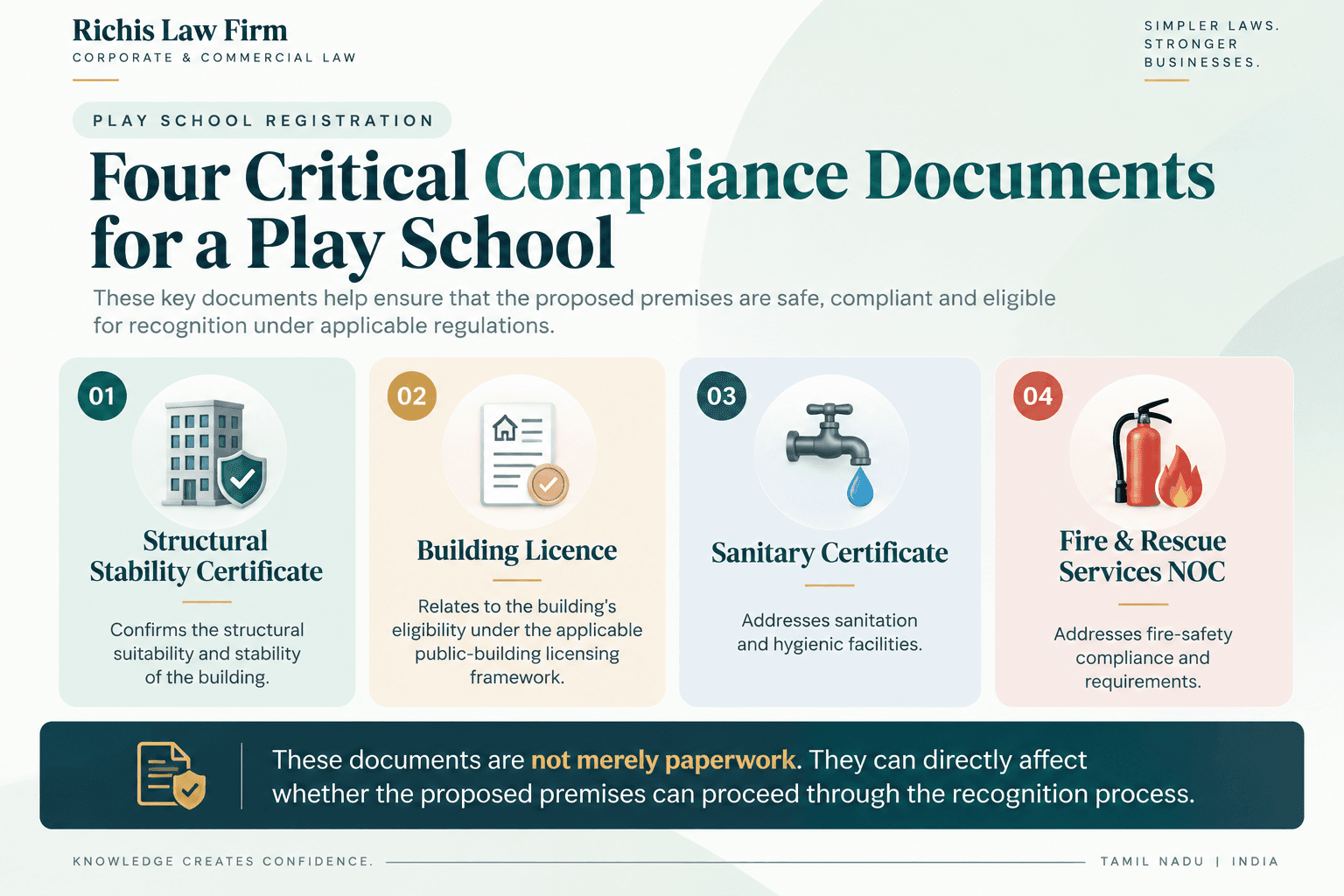
- Structural Stability Certificate
- Public Building Licence
- Sanitary Certificate
- Fire and Rescue Services NOC
- Building Plan and Actual Construction
- Lease Requirements
- Classroom Area and Pupil Capacity
- Playground Requirements
- Drinking Water and Toilet Requirements
- Accessibility and Physical Facilities
- Safety and Security of Children
- Teaching and Non-Teaching Staff
- Endowment and Cash Reserve
- Recognition Application and Timeline
- Recognition Period and 2026 Amendments
- Annual Inspection and Continuing Compliance
- Admissions and Recognition
- Planning Around the Admission Season
- District-Wise Applicability Across Tamil Nadu
- Common Mistakes Made by Founders
- Pre-Lease Legal Due-Diligence Checklist
- Practical Timeline for Establishing a Play School
- When Should You Consult a Lawyer?
- Frequently Asked Questions
- Conclusion
Before signing a lease, founders should conduct a legal checklist before leasing a building for a play school , including verification of permitted use, lease duration, building documentation, structural compliance and the ability to obtain the required approvals.
Introduction
A play school is often one of the first businesses considered by entrepreneurs entering the education sector.
The proposed model may appear straightforward:
- identify a locality with young families;
- take a suitable property on lease;
- renovate the premises;
- purchase furniture and learning materials;
- appoint teachers;
- advertise admissions;
- commence operations.

The difficulty is that the legal suitability of the premises can affect almost every subsequent stage of the project.
A building may be attractive from a commercial perspective but unsuitable from a regulatory perspective.
It may have:
- insufficient land;
- an unsuitable building configuration;
- discrepancies between the approved plan and actual construction;
- inadequate fire-safety arrangements;
- insufficient toilets;
- structural issues;
- difficulties in obtaining a building licence;
- inadequate access;
- an unsuitable lease;
- or other deficiencies that emerge only when the recognition process begins.

The Tamil Nadu Private Schools (Regulation) Rules, 2023 expressly make land, infrastructure and specified certificates conditions relevant to recognition.
This is why property due diligence should precede substantial expenditure.
What is a Play School under Tamil Nadu law?
The terminology used commercially by founders does not necessarily determine the legal category.
A business may describe itself as:
- a play school;
- preschool;
- pre-primary school;
- nursery;
- kindergarten;
- Montessori;
- kids school.
Under Rule 3 of the Tamil Nadu Private Schools (Regulation) Rules, 2023, the category “Play School” includes Kids School, Pre-Primary, Nursery, Kindergarten and Montessori school, by whatever name called.
Accordingly, founders should determine the legal category of the proposed institution before commencing the establishment process.This becomes particularly important where a founder intends to begin with a play school and subsequently expand into LKG, UKG and primary education.
Different categories of private school are subject to different regulatory requirements.
Is registration or recognition required for a pre-school?
Yes. However, it is useful to distinguish between permission to establish a private school and the subsequent certificate of recognition. Under the 2023 Rules, an educational agency establishing a self-financing private school must apply for permission in the prescribed form. The competent authority is required to verify the particulars and documents and ordinarily pass an order granting or refusing permission within three months, subject to the procedural safeguards in the Rules.
Recognition is a separate stage.
The Rules require an application for the certificate of recognition, together with the prescribed fee and documents establishing compliance with the applicable norms. The distinction matters because a founder should not assume:
“I have permission to establish the school, therefore I can start admitting children.” which is wrong
The Rules expressly require the educational agency to certify that no child has been admitted without obtaining the certificate of recognition.
Permission to Establish versus Certificate of Recognition
The broad sequence is therefore:
This distinction should be built into the founder's financial and operational planning.
Who is the Competent Authority?
For a Play School, the 2023 Rules identify the District Educational Officer (Private Schools) as the competent authority for matters including permission and recognition. The appellate authority is the Joint Director (Private Schools), subject to the allocation of functions in the Rules.
This is important for founders because the school may be situated anywhere in Tamil Nadu but the relevant educational administration operates through the applicable educational district and competent authority.
The State currently has 38 districts, including Chennai, Chengalpattu, Kancheepuram, Tiruvallur, Vellore, Ranipet, Tirupathur, Tiruvannamalai, Coimbatore, The Nilgiris, Salem, Namakkal, Erode, Dharmapuri, Krishnagiri, Tiruppur, Madurai, Dindigul, Theni, Sivagangai, Ramanathapuram, Virudhunagar, Thanjavur, Tiruchirappalli, Karur, Pudukkottai, Ariyalur, Perambalur, Nagapattinam, Mayiladuthurai, Tiruvarur, Cuddalore, Villupuram, Kallakurichi, Tirunelveli, Tenkasi, Thoothukudi and Kanniyakumari. (Lok Bhavan)
The substantive private-school framework is statewide; however, the exact administrative route and local technical process may depend upon the location of the proposed premises and the authority having jurisdiction over it.
The Most Important Decision: Choosing the Premises
For many founders, the first practical step is finding a building.
Legally, that may be the wrong starting point.
A founder may see a property with:
- excellent frontage;
- good residential surroundings;
- adequate parking;
- reasonable rent;
- sufficient carpet area;
- proximity to apartments;
- visibility from the main road.
None of those characteristics, by themselves, establish that the premises is suitable for a recognised play school.
The recognition framework requires the educational agency to possess the prescribed land and infrastructure and to furnish specified certificates concerning the building.
The founder should therefore ask:
Can this particular property legally and technically satisfy the requirements applicable to my proposed school?
That question should be answered before substantial money is committed.
Why Legal Advice Should Come Before the Lease
This is one of the most important practical lessons for prospective school founders.
The principle is simple: property selection should follow legal and technical due diligence, not the other way around.
The distinction is significant.
Suppose the proposed building has:
- an attractive rent;
- excellent location;
- adequate rooms;
but cannot obtain the required building licence without substantial alteration. The apparent commercial advantage may disappear. Similarly, a building may be structurally sound but have discrepancies between the sanctioned plan and actual construction.
Or it may be spacious but unsuitable from a fire-safety perspective.
Or the landlord may refuse to execute a lease of sufficient duration.
These are problems that should ideally be discovered before the founder becomes financially committed.
Minimum Land Requirement
The 2023 Rules prescribe a specific minimum land requirement.
For a Play School and Pre-Primary School, the minimum land requirement is one ground, irrespective of the location of the school. For Nursery and Primary School, the requirement is three grounds.
The land required for recognition must be a contiguous single plot and must be surrounded on all sides by a boundary wall. The land must also be owned or held by the educational agency under a valid registered document.
This applies whether the proposed play school is in:
- Chennai;
- Coimbatore;
- Madurai;
- Salem;
- Tiruchirappalli;
- Kanyakumari;
- Tirunelveli;
- Thoothukudi;
- Erode;
- Tiruppur;
- or another district.
The founder should therefore determine the land requirement before negotiating the property.
Building Requirements
The land requirement is only the beginning.
The Rules require infrastructure in accordance with Annexure III. Among other matters, the infrastructure provisions prescribe:
- classrooms;
- minimum classroom area;
- classroom capacity;
- playground arrangements;
- drinking water;
- toilets;
- washing facilities;
- separate toilets for boys and girls;
- staff toilets;
- accessibility-related facilities;
- furniture and other facilities.
The property must therefore be assessed as a school premises not merely as a building capable of accommodating children.
Ground-Floor Classrooms and Property Selection
The material supplied for this article includes the Draft Code of Regulations for Play Schools, 2015.
That draft specifically stated that classrooms should always be on the ground floor and also addressed classroom area, fire-resistant doors/windows, outward-opening doors and emergency escape arrangements.
The practical lesson remains important:
Do not select a multi-storey or otherwise unconventional premises merely because it has sufficient carpet area.
The building's approved configuration, access, safety, infrastructure and certification requirements should be examined before the property is committed.
Structural Stability Certificate
One of the documents expressly required for recognition is the Structural Stability Certificate.
The Rules require this certificate from the competent authority in the Public Works Department or from eligible private engineers from the panel maintained by the District Collectors, in accordance with the Tamil Nadu Public Building (Licensing) Act, 1965.
This requirement has an obvious practical consequence.
A founder should not assume that an old building is acceptable merely because:
“The building has been standing for many years.” ( This alone is not Sufficient)
Age is not the legal test.
The relevant question is whether the building can satisfy the applicable structural and licensing requirements.
Public Building Licence
The recognition framework also requires a Building Licence issued by the competent authority under the Tamil Nadu Public Building (Licensing) Act, 1965.
The Tamil Nadu Government's e-service system presently identifies documentation for a Public Building Licence including:
- building stability certificate;
- Fire and Rescue NOC;
- sanitary certificate from the local body;
- approved building plan;
- ownership deed;
- lease documentation;
- other prescribed documents. (TNeGA)
This demonstrates why property due diligence is so important.
These certificates are not necessarily isolated formalities.
They can be interdependent.
The Public Buildings licensing regime has itself undergone legislative and regulatory changes in 2025, so the current procedure and documentation should be checked when an application is actually made. (Stationery and Printing Department)
Founders should therefore verify the structural stability certificate requirements before committing to the premises, particularly where the building is an existing commercial or converted property.
Sanitary Certificate
The Rules expressly require a Sanitary Certificate issued by the Local Health Authorities.
Sanitary compliance is not simply about having one toilet.
The infrastructure standards address:
- potable drinking water;
- clean and hygienic toilets;
- washing facilities;
- separate facilities for boys and girls;
- staff toilets;
- prescribed ratios of toilets, urinals, hand-wash taps and drinking-water taps.
The current infrastructure norms provide, among other things, one toilet for every 50 children, one urinal for every 20 children, one hand-wash tap for every 20 children and one drinking-water tap for every 20 children.
These requirements should therefore be incorporated into the building design.
The documentation should therefore be checked as part of the premises due-diligence process. Founders can also review the detailed sanitary certificate requirements for a play school before finalising the property.
Fire and Rescue Services NOC
The recognition application must also be supported by a No Objection Certificate from the Station Officer, Fire and Rescue Services Department.
Fire compliance should not be treated as something to be considered after the building is renovated.
It can affect:
- exits;
- access;
- internal layout;
- electrical arrangements;
- fire-fighting equipment;
- emergency movement;
- evacuation planning;
- building configuration.
The earlier 2015 play-school material also contemplated fire extinguishers and an evacuation plan.
Tamil Nadu's fire-safety statutory framework has also been amended in 2025 and 2026, making it particularly important to verify the current departmental requirements at the time of application rather than relying upon an old checklist. (Stationery and Printing Department)
Because fire-safety compliance can affect the physical configuration and usability of the premises, founders should examine the Fire NOC requirements for a play school before committing to construction or substantial alterations.
Building Plan and Actual Construction
One of the most overlooked issues in property selection is the distinction between:
the building shown in the approved plan and the building that physically exists.
Problems may arise where there are:
- unauthorised additions;
- enclosed verandahs;
- altered entrances;
- additional rooms;
- demolished walls;
- converted spaces;
- changes to the approved use;
- discrepancies in dimensions.
A founder should therefore obtain and examine the approved building plan before signing the lease.
The question should be:
Does the building that I am taking on lease correspond with the legally approved building?
If not, the founder should understand what rectification or approval would be required before committing capital.
Lease Requirements
The lease itself is a major component of the compliance structure.
Under Rule 8, the land must be owned or held in lease by the educational agency under a valid registered document. Where the land is held on lease, the lease deed must generally be for not less than five years while the Rules contain a shorter minimum period for leases executed by the Government.
This means that an ordinary short-term rental arrangement may not be sufficient for the recognition framework.
Before signing, the founder should examine:
- duration;
- registration;
- permitted use;
- educational use;
- rights to modify the building;
- rights to install safety equipment;
- signage;
- access;
- parking;
- utilities;
- repairs;
- structural responsibility;
- cooperation with statutory authorities;
- termination rights;
- renewal;
- responsibility for obtaining certificates.
The landlord's cooperation can be crucial.
A founder should not sign a lease assuming that the owner will later cooperate with every application.
The lease should be structured with the intended educational use and compliance process in mind.
Classroom Area and Pupil Capacity
The 2023 Rules prescribe minimum classroom standards.
Annexure III requires a minimum classroom area of 400 sq. ft., one room for each class, and at least 10 sq. ft. of floor space per pupil and 40 sq. ft. for a teacher.
The Rules also provide that a maximum of 15 pupils shall be accommodated in a classroom for pre-kindergarten classes.
This is important for business planning.
A founder should not first decide:
“I want 60 admissions.”
and then ask whether the premises can accommodate 60 children.
The sequence should be reversed:
What is the legally and practically supportable capacity of the proposed premises?That capacity should inform the business plan.
Playground Requirements
The school should also have adequate playground space as part of the campus. Where sufficient space is not available, the Rules contemplate arrangements for taking pupils to an adjoining Corporation, Municipality or Village Panchayat area or park/playground for outdoor activities, subject to pupil safety. This is another reason why carpet area alone is an inadequate measure of property suitability. The founder should examine the entire site.
Drinking Water and Toilet Requirements
The infrastructure requirements include:
- potable drinking water;
- clean and hygienic toilets;
- washing facilities;
- separate toilets for boys and girls;
- separate staff toilets;
- signage;
- ramps and other accessibility facilities;
- appropriate furniture;
- recreational and physical-education facilities;
- facilities for safeguarding pupil health.
For a play school, these requirements are particularly important because the users are very young children. The earlier 2015 material similarly addressed washing facilities, drinking water, water storage, toilets, diaper facilities and hygiene.
Accessibility and Physical Facilities
The 2023 infrastructure standards also require appropriate accessibility features, including ramps at toilets and entry/exit points for wheelchair users and auditory signals in elevators/lifts where applicable under the Rights of Persons with Disabilities Act, 2016.
Accessibility should therefore be incorporated into the design rather than treated as an afterthought.
Safety and Security of Children
Recognition is not merely about land and certificates. The Rules also require compliance with prescribed safety and security norms. The educational agency must certify compliance with the safety and security norms applicable under the Act, Rules, Codes and guidelines.
The 2023 Rules contain a dedicated safety-and-security framework, including requirements relating to the safety of pupils inside and outside the school.
The framework should therefore be treated as an operational obligation.
A school should have systems addressing:
- safe entry and exit;
- supervision;
- emergency arrangements;
- child protection;
- fire safety;
- construction activity;
- transport safety where transportation is provided;
- emergency contact information;
- appropriate staff conduct.
Teaching and Non-Teaching Staff
The legal process does not end with the building. The recognition application requires the educational agency to certify that the teaching staff to be appointed possess the qualifications prescribed under Annexure IV-A. The earlier Play School Code also addressed teaching qualifications, pupil-teacher ratios and qualifications of non-teaching staff.
The founder should therefore establish the staffing structure before admissions begin.
This includes:
- teachers;
- non-teaching staff;
- support staff;
- child-care responsibilities;
- safety responsibilities;
- training;
- documentation.
Endowment and Cash Reserve
This is an important requirement that founders sometimes overlook.
For a Play School, the 2023 Rules require a minimum endowment of ₹50,000, maintained in the name of the school in the prescribed form for at least seven years.
The educational agency must also deposit, in the name of the private school, an amount equivalent to one month's salary of the staff employed, as a cash reserve that can be used for salary disbursement.
These should therefore be incorporated into the initial financial planning.
Recognition Application and Timeline
This is one of the most commercially significant provisions.
The Rules require the application for the certificate of recognition to be submitted at least six months before the commencement of the academic year in which the school proposes to commence the process of admission.
The competent authority is ordinarily required to pass an order granting or refusing recognition within three months from receipt of the application, subject to the prescribed process.
This does not mean that a founder should simply wait until six months before admissions.
The six-month requirement should be treated as a minimum statutory planning point, not necessarily the entire project timeline.
The founder still has to account for:
- property due diligence;
- lease negotiations;
- building modifications;
- structural certification;
- building licence;
- sanitation;
- fire safety;
- documentation;
- inspection;
- rectification;
- recognition;
- recruitment;
- marketing;
- admissions.
Recognition Period and 2026 Amendments
This is an important current update.
The original 2023 Rules provided for recognition linked to the period specified in the structural stability certificate or building licence, whichever was earlier.
Tamil Nadu amended the Rules in March 2026.
The March 14, 2026 amendment provides that the certificate of recognition is generally valid for three years. It further provides that an educational agency which has obtained recognition for three consecutive terms and is not in violation of the Act or Rules may opt for recognition for twenty years.
The March 2026 amendments also changed the inspection regime.
The competent authority must carry out inspection of every private school at least once in every academic year, and the annual inspection fee prescribed for a Play School is ₹2,000.
This is significant.
Recognition should no longer be viewed as:
“Get the certificate once and forget about compliance.”
The regulatory framework expressly contemplates continuing compliance and annual inspection.
Annual Inspection and Continuing Compliance
The March 2, 2026 amendment introduced an additional continuing obligation.
The educational agency is required to upload a self-declaration of compliance with the Act and Rules on or before 30 April every year, through the portal specified by the Government.
The same amendment also provides that the land, buildings and facilities of a recognised private school are to be used primarily and exclusively for academic instruction, co-curricular and extra-curricular activities, student welfare programmes and school functions conducted under the authority and supervision of the educational agency. It restricts certain external political, ideological, communal/divisive or unrelated activities on school premises.
This is an important illustration of how the compliance framework has evolved beyond merely obtaining initial recognition.
Admissions and Recognition
One of the most important rules for founders is simple:
Do not treat admissions as something that can begin while recognition is still pending.
The recognition application requires the educational agency to certify that no child has been admitted without obtaining the certificate of recognition.
This has a direct commercial consequence.
A founder cannot safely structure the project around:
“We will start taking admissions now and complete the recognition process afterwards.”
The recognition process needs to be integrated into the launch strategy.
Planning Around the Admission Season
Once the recognition position has been addressed, founders should also consider what information can properly be collected from parents during the admissions process. Our guide to play school admission form requirements in Tamil Nadu examines the information schools may seek from parents.
This is where legal compliance and commercial planning intersect.
Play schools often experience their principal admissions cycle around the beginning of the academic year, particularly after the vacation period.
That means the founder may have a relatively narrow period in which parents are actively looking for:
- play schools;
- nursery;
- kindergarten;
- Montessori;
- LKG;
- UKG.
If the founder begins the recognition process only shortly before this period, the school may not be operationally ready when the principal demand arises.
The better approach is to plan backwards.
For example:
The precise project timeline will depend on the property and the authorities involved, but the central point remains:
Do not work forwards from the date you find a building. Work backwards from the date you intend to commence lawful admissions.
District-Wise Applicability Across Tamil Nadu
This guide is intended for founders establishing Play Schools throughout Tamil Nadu.
The State's 38 districts are:
Ariyalur, Chengalpattu, Chennai, Coimbatore, Cuddalore, Dharmapuri, Dindigul, Erode, Kallakurichi, Kancheepuram, Karur, Krishnagiri, Madurai, Mayiladuthurai, Nagapattinam, Kanniyakumari, Namakkal, Perambalur, Pudukkottai, Ramanathapuram, Ranipet, Salem, Sivaganga, Tenkasi, Thanjavur, Theni, Tiruvallur, Tiruvarur, Thoothukudi, Tiruchirappalli, Tirunelveli, Tirupathur, Tiruppur, Tiruvannamalai, The Nilgiris, Vellore, Viluppuram and Virudhunagar. (Lok Bhavan)
The substantive private-school framework is statewide.
However, the local administrative and technical authorities involved with the property may differ depending upon the location.
For example, a proposed premises in:
- Chennai;
- a Corporation area;
- a Municipality;
- a Town Panchayat;
- or a Village Panchayat
may encounter different local authorities and procedures for building, sanitation, planning and related certifications.
The founder should therefore distinguish between:
Statewide legal requirements and
location-specific administrative procedures.
This distinction is particularly important when obtaining building-related certificates.
Common Mistakes Made by Founders
1. Choosing the property before checking the law
This is perhaps the most expensive mistake.
2. Paying a large advance before due diligence
If the building subsequently proves unsuitable, the founder may already have substantial money at risk.
3. Assuming sufficient carpet area means sufficient compliance
Floor area alone does not establish compliance.
4. Assuming an existing school or daycare makes the property automatically suitable
Previous use does not necessarily establish present compliance.
5. Relying entirely on the landlord's assurances
Statements such as:
“The building is approved.”or
“A school was already operating here.”
should be independently verified.
6. Ignoring the approved building plan
The physical building should be compared with the approved plan.
7. Treating Fire NOC as a final formality
Fire safety can affect the building configuration itself.
8. Signing an inadequate lease
The current recognition framework contemplates a registered lease of at least fifteen years where the land is leased, subject to the Government-lease exception.
9. Starting renovations before determining the compliance requirements
A renovation designed without reference to the statutory requirements may have to be altered again.
10. Applying for recognition too late
The Rules themselves require the recognition application at least six months before the relevant academic year in which admissions are proposed to commence.
11. Advertising or admitting children before recognition
The Rules expressly require certification that children have not been admitted without recognition.
12. Treating recognition as a one-time event
The 2026 amendments introduce annual inspection and annual self-declaration requirements.
Pre-Lease Legal Due-Diligence Checklist
Before signing the lease, a founder should consider obtaining a legal and technical review of the following.
Property
- Title documents
- Ownership
- Survey details
- Land extent
- Boundary
- Access
- Permitted use
- Encumbrances/restrictions
- Existing building approvals
Building
- Approved building plan
- Actual building configuration
- Structural condition
- Classroom dimensions
- Entrances and exits
- Fire-safety feasibility
- Electrical arrangements
- Toilet facilities
- Water supply
- Accessibility
- Playground arrangements
Certificates
- Structural Stability Certificate
- Building/Public Building Licence
- Sanitary Certificate
- Fire and Rescue Services NOC
These are expressly relevant to the recognition framework.
Lease
- Registered lease
- Adequate duration
- Educational use expressly permitted
- Right to undertake necessary alterations
- Right to obtain statutory approvals
- Landlord cooperation
- Responsibility for structural repairs
- Responsibility for statutory compliance
- Termination and renewal provisions
School operations
- Teaching qualifications
- Non-teaching staff
- Safety procedures
- Child-protection measures
- Endowment
- Salary cash reserve
- Admission planning
- Recognition timeline
Practical Timeline for Establishing a Play School
A founder could broadly structure the project as follows.
Phase 1 — Legal planning
Before selecting the property
- determine the proposed school category;
- identify the educational agency;
- understand the applicable regulations;
- consult a lawyer;
- establish a compliance checklist.
Phase 2 — Property identification
Identify prospective properties.
Do not immediately sign the lease.
Phase 3 — Legal and technical due diligence
Examine:
- title;
- land extent;
- building plan;
- actual construction;
- lease feasibility;
- structural feasibility;
- fire-safety feasibility;
- sanitation;
- access;
- school infrastructure.
Phase 4 — Property commitment
Only after the property has passed preliminary due diligence should the founder proceed with substantial expenditure.
Phase 5 — Building compliance
Complete the necessary technical and statutory requirements.
Phase 6 — Permission and recognition process
Prepare and submit the prescribed applications and supporting documents within the applicable timelines.
Phase 7 — Inspection and rectification
Address any deficiencies identified during verification or inspection.
Phase 8 — Recognition
Obtain the certificate of recognition.
Phase 9 — Final operational preparation
Complete:
- staffing;
- furniture;
- safety systems;
- curriculum arrangements;
- parent documentation;
- admission materials;
- marketing.
Phase 10 — Admissions
Commence admissions only in accordance with the applicable recognition requirements.
When Should You Consult a Lawyer?
Ideally, before you sign the lease.
Not: after the building has been renovated.
Not: after the Fire NOC has been rejected.
Not: after the recognition application has been returned.
Not: after the founder has already spent substantial money.
The most useful stage for legal advice may be the stage at which the founder has identified a prospective property but has not yet irreversibly committed to it.
A lawyer can assist with:
- identifying the applicable regulatory framework;
- reviewing the proposed property;
- examining title documents;
- reviewing the lease;
- identifying potential compliance problems;
- coordinating with architects and engineers;
- reviewing statutory documentation;
- advising on the recognition process;
- identifying issues before substantial expenditure.
The Property Should Be Examined as a Regulatory Package:
A founder should not consider the following as unrelated documents:
- Structural Stability Certificate
- Public Building Licence
- Sanitary Certificate
- Fire NOC
- Approved Building Plan
- Lease
- School Infrastructure
These are parts of the same compliance architecture.
A building that fails one component may affect the feasibility of the entire project.
The Tamil Nadu Government's own Public Building Licence service lists the stability certificate, fire NOC, sanitary certificate, approved building plan and ownership/lease documentation among the supporting requirements. (TNeGA) . This is why property selection is a legal decision as much as a commercial decision.
Reality Check
The property with the lowest rent may not be the cheapest property.
Reality Check
The property with the lowest rent may not be the cheapest property. When choosing premises for a play school, the founder should consider not only the monthly rent but also the cost of modifications, statutory compliance, certification, delay and other requirements necessary to make the premises suitable for the proposed school.
A building with a slightly higher rent may, in some circumstances, have a configuration that is more compatible with the applicable requirements and therefore require fewer modifications before the recognition process can proceed.
The founder should not compare the properties solely by monthly rent.
The real comparison may involve:
Rent + renovation + compliance + delay + certification risk + lost admission season.
A founder who conducts due diligence before committing to the property can identify these issues when they are still manageable.
A Better Way to Think About Play School Registration
Starting a play school should not be understood as:
“How do I get my registration?”
The more accurate question is:
“How do I establish a premises and institution that can lawfully satisfy the requirements for recognition and continued operation?”
That change in perspective is important.
The law regulates not merely the application form but the institution behind it.
Conclusion: Do Not Choose the Building First and the Law Later
Starting a play school in Tamil Nadu requires more than finding a suitable locality and creating an attractive learning environment.
The legal process begins much earlier.
A founder should first understand:
- the applicable school category;
- the permission process;
- recognition requirements;
- land requirements;
- building requirements;
- lease requirements;
- structural stability;
- public building licensing;
- sanitation;
- fire safety;
- classroom capacity;
- playground arrangements;
- accessibility;
- staffing;
- endowment;
- continuing compliance;
- and the timing of admissions.
The current Rules expressly require a Play School seeking recognition to satisfy prescribed land and infrastructure requirements and to furnish a Structural Stability Certificate, Building Licence, Sanitary Certificate and Fire and Rescue Services NOC.
The rules also require recognition to be planned sufficiently in advance of the proposed admission cycle, while the 2026 amendments have strengthened continuing oversight through annual inspection and annual self-declaration.
For founders across Tamil Nadu, the practical lesson is therefore straightforward:
Do not spend first and investigate compliance later.
Before paying a substantial advance, signing a long-term lease or commencing expensive renovation, have the proposed premises examined from a legal and technical perspective.
The most expensive mistake may not be failing to obtain a certificate.
It may be choosing a property that was never capable of satisfying the requirements in the first place.
The first question should therefore not be:
“How do I register my play school?”
It should be: “Is the property I am about to commit my money to legally and technically capable of becoming the play school I intend to operate?”. That is where the process should begin.
Continue Reading
Frequently Asked Questions
Is a Play School covered under the Tamil Nadu private-school framework?
Yes. The 2023 Rules expressly define Play School to include Kids School, Pre-Primary, Nursery, Kindergarten and Montessori schools.
How much land is required?
For a Play School and Pre-Primary School, the 2023 Rules prescribe one ground irrespective of location.
Can I run the school in a rented building?
A leased property can form part of the recognition framework, but the land must be held by the educational agency through a valid registered document and generally the lease must be for at least five years.
Is a Structural Stability Certificate required?
Yes. It is expressly included among the documents required for recognition.
Is a Public Building Licence required?
Yes. The recognition requirements include a Building Licence under the Tamil Nadu Public Building (Licensing) Act, 1965.
Is a Sanitary Certificate required?
Yes. The Rules require a Sanitary Certificate issued by the Local Health Authorities.
Is Fire NOC required?
Yes. The recognition requirements include an NOC from the Station Officer, Fire and Rescue Services Department.
Can I admit children while recognition is pending?
The recognition application requires the educational agency to certify that no child has been admitted without obtaining the certificate of recognition.
The recognition application requires the educational agency to certify that no child has been admitted without obtaining the certificate of recognition.
The substantive private-school framework is statewide. However, the local authorities and administrative procedures relating to the premises, building, sanitation, fire safety and other local approvals can depend upon the location of the proposed school. The State currently has 38 districts
Disclaimer
This article is for general information only and does not constitute legal advice or create an advocate-client relationship. Statutes, rules, rates and compliance requirements change over time and vary by circumstance.
RICHIS LAW FIRM — Strategic Business Legal Advisors.
Safeguarding business interests and enabling growth across Tamil Nadu.
Richis Jesvanth J
B.Com., LL.B., LL.M. (Corporate & Commercial Law), CS Finalist
Practising in Company Law
Pavyaa Angelina K
B.B.A., LL.B.
Practising in Taxation Law