MSME Legal Provisions: Legal Guidance for Business Owners
Understand your legal rights under the MSMED Act, 2006, including delayed payments, statutory interest, MSME dispute resolution, MSEFC proceedings and the MSME ODR Portal. Explore practical legal information for MSME business owners from Richis Law Firm, Nagercoil.

MSME Legal Provisions: A Business Owner’s Guide to the MSMED Act, 2006 and Dispute Resolution
A practical legal kit for understanding MSME rights, delayed payments and the process of recovering business dues
Running a business involves more than supplying goods, delivering services and issuing invoices. Businesses must also understand their legal rights, payment obligations, contractual responsibilities and available remedies when a commercial transaction goes wrong.
For micro and small enterprises, delayed payments can create serious cash-flow difficulties. A customer’s unpaid invoice may affect the ability to pay employees, purchase raw materials, meet loan obligations and accept new orders.
The Micro, Small and Medium Enterprises Development Act, 2006 (MSMED Act) provides a legal framework for the development of MSMEs and includes specific provisions addressing delayed payments to eligible micro and small enterprise suppliers.
This MSME Legal Provisions guide by Richis Law Firm is intended to help business owners understand the principal legal framework, identify relevant provisions and follow the broad process available for resolving delayed-payment disputes.
1. What is the MSMED Act, 2006?
The MSMED Act, 2006 is an Indian law dealing with the development and promotion of micro, small and medium enterprises.
For business owners, one of its most significant features is Chapter V, which deals with delayed payments to micro and small enterprises.
The Act addresses matters including:
- The time allowed for payment to eligible suppliers.
- Interest payable when payments are delayed.
- Recovery of amounts due to eligible suppliers.
- References to the Micro and Small Enterprises Facilitation Council (MSEFC).
- Conciliation and arbitration of qualifying disputes.
- Legal requirements concerning challenges to certain awards or orders.
The delayed-payment provisions are particularly important to businesses that supply goods or render services to companies, public-sector entities and other commercial buyers.
Who benefits from the delayed-payment provisions?
The special delayed-payment framework principally concerns eligible micro and small enterprise suppliers. A business should not assume that every enterprise classified as an MSME, including a medium enterprise, automatically receives the same remedies.
Eligibility, registration, the nature of the transaction and the applicable law must be examined before a claim is pursued.
2. The main legal provisions business owners should know
The following provisions provide a starting point for understanding the MSMED Act.
Section 7 — Classification of enterprises
Section 7 deals with the classification of micro, small and medium enterprises.
Enterprise classification is relevant because the legal protections and benefits available to a business may depend on its category.
Business owners should verify their enterprise classification and the applicable government notifications rather than relying solely on how their business describes itself.
Section 8 — Registration of enterprises
Section 8 concerns the filing of the memorandum or registration particulars of an enterprise under the applicable framework.
Udyam Registration is an important part of the present MSME registration system. Business owners should maintain accurate registration information and preserve their registration records.
Registration alone does not automatically establish every element of a delayed-payment claim. The supplier must still demonstrate the relevant transaction, amount due and applicable legal requirements.
Section 15 — Liability of the buyer to make payment
Section 15 addresses the time within which a buyer must pay an eligible micro or small enterprise supplier.
Where there is a written agreement specifying a payment period, the agreed period cannot exceed 45 days from the date of acceptance or deemed acceptance of the goods or services.
Where there is no such agreement, payment must be made before the statutory appointed day.
The relevant dates depend on the statutory definitions of acceptance, deemed acceptance and appointed day. The invoice date should not automatically be treated as the starting point in every case.
Section 16 — Interest on delayed payment
Section 16 provides for compound interest with monthly rests at three times the bank rate notified by the Reserve Bank of India, where the statutory requirements are satisfied.
This provision can make prolonged payment delays financially significant.
A supplier considering a claim should prepare an accurate calculation using the legally relevant dates, applicable rate, outstanding principal and any part-payments received.
Section 17 — Recovery of the amount due
Section 17 addresses the buyer’s liability to pay the amount due to the supplier together with the interest payable under Section 16.
For a business owner, this means that a qualifying delayed-payment claim may involve both the outstanding principal and statutory interest, subject to the facts and applicable law.
Section 18 — Reference to the Facilitation Council
Section 18 provides the statutory mechanism for referring qualifying disputes concerning amounts due under the delayed-payment provisions to the Micro and Small Enterprises Facilitation Council.
The Council may undertake conciliation or refer the matter to a mediation service provider under the applicable framework. If conciliation fails, the dispute may proceed to arbitration in accordance with the Act.
This is a central provision for businesses considering formal dispute resolution over unpaid invoices.
Sections 19–24 — Additional protections and legal requirements
These provisions address important matters connected with disputes and delayed payments, including:
- Section 19: Deposit requirements for certain applications challenging covered awards, decrees or orders.
- Section 20: Establishment of Micro and Small Enterprises Facilitation Councils.
- Section 21: Composition of the Facilitation Council.
- Section 22: Disclosure of specified outstanding-payment information in annual accounts.
- Section 23: Treatment of interest payable under the Act for income-tax deduction purposes.
- Section 24: Overriding effect of the delayed-payment provisions where they conflict with inconsistent laws.
The effect of these provisions depends on the particular facts and the law in force when the issue arises.
3. Other laws that may be relevant to an MSME payment dispute
The MSMED Act is not the only law that may matter in a commercial dispute.
Depending on the transaction and stage of the dispute, business owners and their legal advisers may also need to consider:
The Indian Contract Act, 1872
Relevant to contractual obligations, breach of contract, compensation and other questions arising from commercial agreements.
The Arbitration and Conciliation Act, 1996
Relevant to arbitration proceedings and challenges to arbitral awards, including the statutory framework applicable to disputes under the MSMED Act.
The Insolvency and Bankruptcy Code, 2016
Potentially relevant where insolvency proceedings or the treatment of a debt under insolvency law becomes an issue. An unpaid invoice does not, by itself, guarantee that insolvency proceedings are available or appropriate.
Applicable tax and accounting provisions
Relevant to record-keeping, financial reporting and the treatment of specified interest or outstanding amounts.
Not every law applies to every transaction. The appropriate legal route should be selected after examining the contract, parties, documents and nature of the dispute.
4. MSME delayed-payment dispute: How does the process work?
A business owner should understand the broad process before initiating a claim.
Stage 1 — Identify the unpaid amount
Start by identifying the invoices that remain unpaid and reconciling the amount claimed.
Prepare a statement showing the invoice number, invoice amount, date of supply, amount received, balance outstanding and relevant payment terms.
Stage 2 — Collect the supporting documents
Organise the documents that establish the transaction and the amount due.
These may include:
- Udyam Registration details.
- Purchase orders and written agreements.
- Tax invoices.
- Delivery challans, goods-receipt records or service-completion evidence.
- Emails and messages confirming the order, delivery, acceptance or payment discussions.
- Account statements and payment records.
- Details of any dispute or written objection raised by the buyer.
- An invoice-wise calculation of the outstanding amount and applicable interest.
The exact documentation required depends on the facts and the current filing procedure.
Stage 3 — Check eligibility and applicable requirements
Before filing, verify that the supplier and transaction meet the requirements of the delayed-payment framework.
This includes checking the enterprise category, relevant registration details, dates of supply and acceptance, payment terms and the legal provisions applicable to the claim.
Stage 4 — File through the MSME ODR Portal
The Ministry of MSME provides an Online Dispute Resolution Portal for delayed-payment disputes.
Official portal: https://odr.msme.gov.in/
The portal provides a digital route for initiating and managing the dispute-resolution process. Business owners should consult the current scheme guidelines, eligibility requirements and filing instructions before submitting an application.
Stage 5 — Pre-MSEFC settlement stage
The ODR scheme provides a pre-MSEFC stage that may include a Digital Guided Pathway and online negotiation.
The Digital Guided Pathway can assist the parties in exploring a possible resolution. It should not be confused with a binding judicial or arbitral decision.
Under the scheme guidelines, the pre-MSEFC stage is voluntary and based on the parties’ consent. Where a party opts out, the matter may proceed to the MSEFC stage under the applicable procedure.
Stage 6 — MSEFC conciliation
If the dispute proceeds to the MSEFC stage, conciliation or mediation is undertaken under the applicable legal framework.
The purpose is to explore whether the parties can resolve the dispute by agreement.
If a settlement is reached, its terms and legal effect should be properly documented.
Stage 7 — Arbitration if settlement fails
Where conciliation fails, the matter may proceed to arbitration as provided under the MSMED Act and the applicable arbitration framework.
Arbitration is a formal dispute-resolution process that can result in an arbitral award. It is distinct from the earlier settlement or conciliation stage.
Stage 8 — Award and recovery
If an award is made, the next steps may include compliance, enforcement or a legally permissible challenge.
The correct procedure depends on the nature of the decision, the applicable statutory provisions, limitation periods and any relevant court orders.
Important: The stages described above are a general overview. The exact route depends on the ODR scheme, the applicable law and the facts of the dispute.
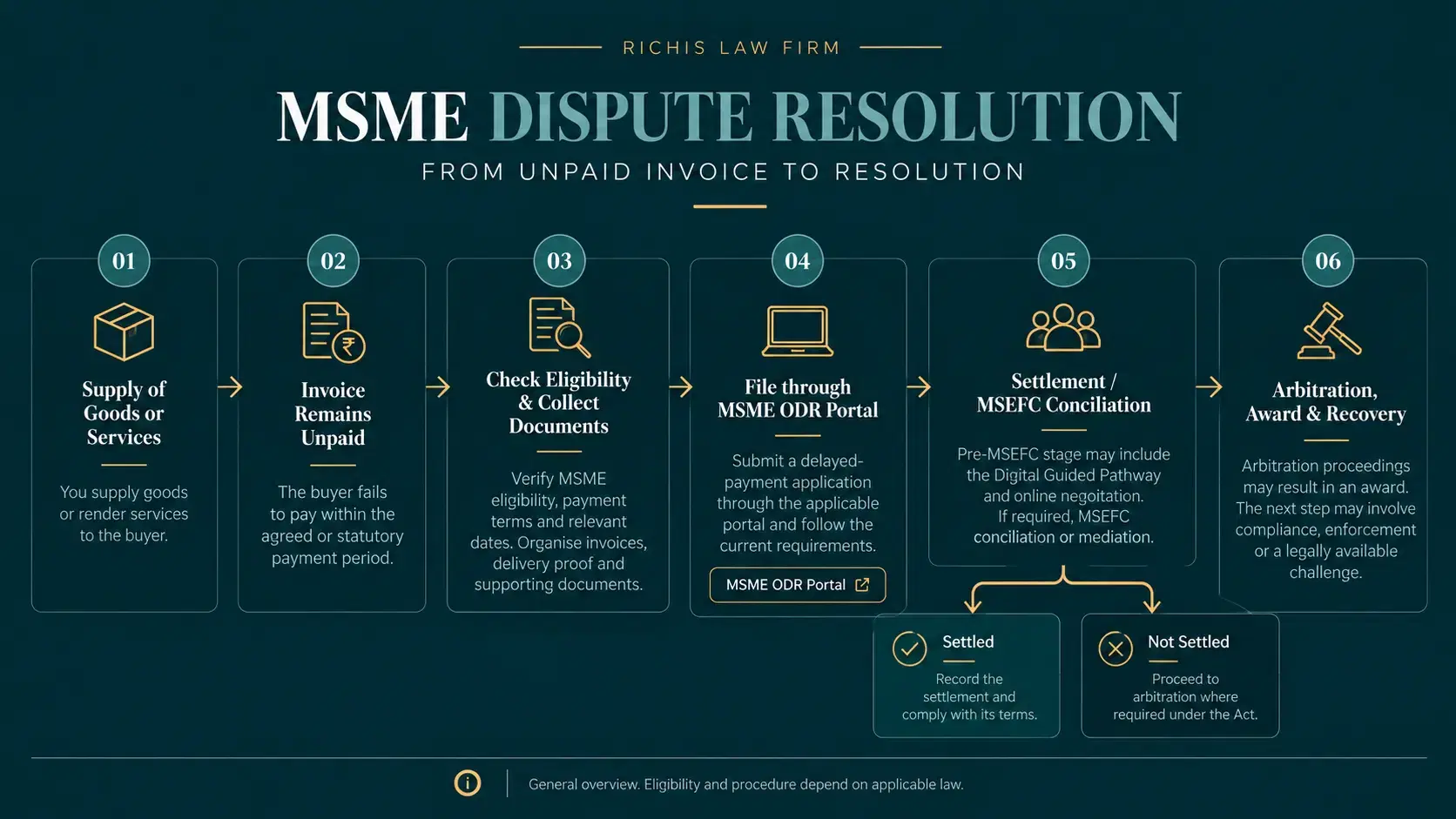
5. The MSME dispute-resolution flow at a glance
MSME Dispute-Resolution Flow at a Glance
Understand the broad process of resolving delayed-payment disputes, from an unpaid invoice to settlement, arbitration and recovery.
Supply of Goods or Services
The business supplies goods or renders services to the buyer.
Invoice Remains Unpaid
The buyer fails to pay within the applicable payment period.
Check Eligibility and Payment Terms
Verify enterprise eligibility, payment terms and relevant dates.
Collect Supporting Documents
Organise invoices, delivery proof, purchase orders, correspondence and payment records.
File a Delayed-Payment Application
Use the applicable portal and follow the current filing requirements.
Visit MSME ODR Portal ↗Pre-MSEFC Settlement Stage
The process may include the Digital Guided Pathway and online negotiation, subject to the applicable scheme.
Has the Dispute Been Settled?
Document the settlement and comply with its terms.
Proceed to the MSEFC stage under the applicable procedure.
MSEFC Conciliation or Mediation
The parties are given an opportunity to resolve the dispute through the applicable conciliation process.
Has Conciliation Resulted in a Settlement?
Record the settlement and identify the applicable compliance or enforcement route.
Proceed to arbitration where required under the Act.
Arbitral Award
The arbitration proceedings may result in an award determining the dispute.
Compliance, Enforcement or Challenge
The next step may involve compliance with the award, enforcement or a legally available challenge, depending on the circumstances.
This flow is a general guide to the MSME delayed-payment dispute-resolution process. It does not guarantee a particular outcome or mean that every case will follow an identical sequence. Eligibility, procedure and applicable law should be verified before taking action.
6. What should a business owner prepare before seeking legal assistance?
A business owner can make the initial review more efficient by preparing a simple legal file.
Business and registration records
- Enterprise details and Udyam Registration information.
- Supplier and buyer names and addresses.
- Relevant contract or purchase order.
Transaction records
- Invoice list.
- Delivery or service-completion records.
- Correspondence about acceptance, quality, payment and disputes.
Payment records
- Original amount claimed.
- Part-payments received.
- Balance outstanding.
- Payment due dates.
- Interest calculation, where applicable.
Dispute records
- Payment demands and reminders.
- Written objections raised by the buyer.
- Previous settlement discussions.
- Any legal notices, portal filings, Council communications, court proceedings or arbitral decisions.
Organising these records helps identify the key issues before choosing a recovery strategy.
7. What should buyers and businesses purchasing from MSMEs understand?
The MSMED Act is also relevant to businesses that purchase goods or services from eligible micro and small enterprise suppliers.
Buyers should maintain clear purchase orders, delivery and acceptance records, invoice records and payment schedules. Where there is a genuine dispute about a supply, the relevant facts and objections should be recorded clearly and promptly.
Businesses should also understand that statutory payment obligations may apply even where their internal approval or accounting processes take longer.
A buyer facing a claim should review the transaction documents, the amount claimed, any payments made and the applicable statutory provisions before deciding how to respond.
8. The MSMED Amendment Act, 2026
The Micro, Small and Medium Enterprises Development (Amendment) Act, 2026 received Presidential assent on 13 August 2026. It introduces amendments concerning matters such as enterprise registration, settlement of specified receivables through TReDS, dispute-resolution timelines, enforcement and certain challenges to awards.
However, the Amendment Act provides for commencement by notification in the Official Gazette, and different provisions may commence on different dates.
For that reason, a business owner should not assume that every amendment became operational on the date of assent. Before relying on a particular amended provision, the relevant commencement notification and applicable rules should be verified.
The existing MSMED Act framework and the 2026 amendments should be read together with attention to which provisions are legally in force on the relevant date.
9. A practical legal checklist for MSME businesses
Before pursuing a delayed-payment matter, ask:
- Is the supplier an eligible micro or small enterprise for the relevant claim?
- Are the registration details accurate?
- Is there a clear record of the goods supplied or services rendered?
- Can the date of delivery, acceptance or deemed acceptance be established?
- Are the written payment terms available?
- Has the outstanding principal been reconciled?
- Have part-payments and any disputed invoices been accounted for?
- Is the interest calculation based on the applicable statutory rules?
- Have the current portal requirements and applicable legal procedure been checked?
- Are there any limitation, jurisdiction or other procedural issues requiring legal review?
If important information is missing, address those gaps before proceeding wherever possible.
Conclusion
The MSMED Act, 2006 is an important part of the legal framework for eligible micro and small enterprise suppliers facing delayed payments.
Understanding the relevant provisions can help business owners identify their rights, maintain better transaction records and understand the route from an unpaid invoice to settlement, conciliation, arbitration and recovery.
The MSME ODR Portal adds a digital route for dispute resolution, while the 2026 Amendment Act introduces further changes whose commencement must be verified provision by provision.
For business owners, the practical starting point is straightforward: maintain clear records, understand the applicable legal provisions, check eligibility and select the appropriate process for the dispute.
Need Legal Guidance for Your MSME?
Facing delayed payments or a business dispute? Get legal guidance on MSME rights, the MSMED Act and commercial dispute resolution.
MSME Legal Provisions • Business Legal Guidance
Disclaimer: This material is intended for general legal information and educational purposes. It is not a legal opinion or advice for any specific business or dispute. The applicable law, commencement notifications, rules, eligibility and procedural requirements should be verified before taking action.
Continue Reading
Disclaimer
This article is for general information only and does not constitute legal advice or create an advocate-client relationship. Statutes, rules, rates and compliance requirements change over time and vary by circumstance.
RICHIS LAW FIRM — Strategic Business Legal Advisors.
Safeguarding business interests and enabling growth across Tamil Nadu.
Richis Jesvanth J
B.Com., LL.B., LL.M. (Corporate & Commercial Law), CS Finalist
Practising in Company Law
Pavyaa Angelina K
B.B.A., LL.B.
Practising in Taxation Law