What Is GST? A Complete Guide for Businesses in Tamil Nadu
Understand GST in Tamil Nadu, including its purpose, pre-GST tax system, compliance requirements, Input Tax Credit, documentation, scrutiny and practical business implications.
.png)
Prefer to Listen?
Listen to a short audio briefing on GST and its practical implications for businesses in Tamil Nadu.
- Introduction
- Before GST: How India's Indirect Tax System Worked
- Why Was This System Considered Challenging?
- Practical Challenges Under the Pre-GST Regime
- Have the Objectives Behind GST Been Achieved? A Business Perspective
- Why Is Every Business Trying to Understand GST More Than Ever Before?
- Understanding GST Beyond the Bare Act
- How Should Businesses Actually Understand GST?
- What Should Every Business Focus On?
- Conclusion: Understanding GST Is About Understanding Your Business
Introduction
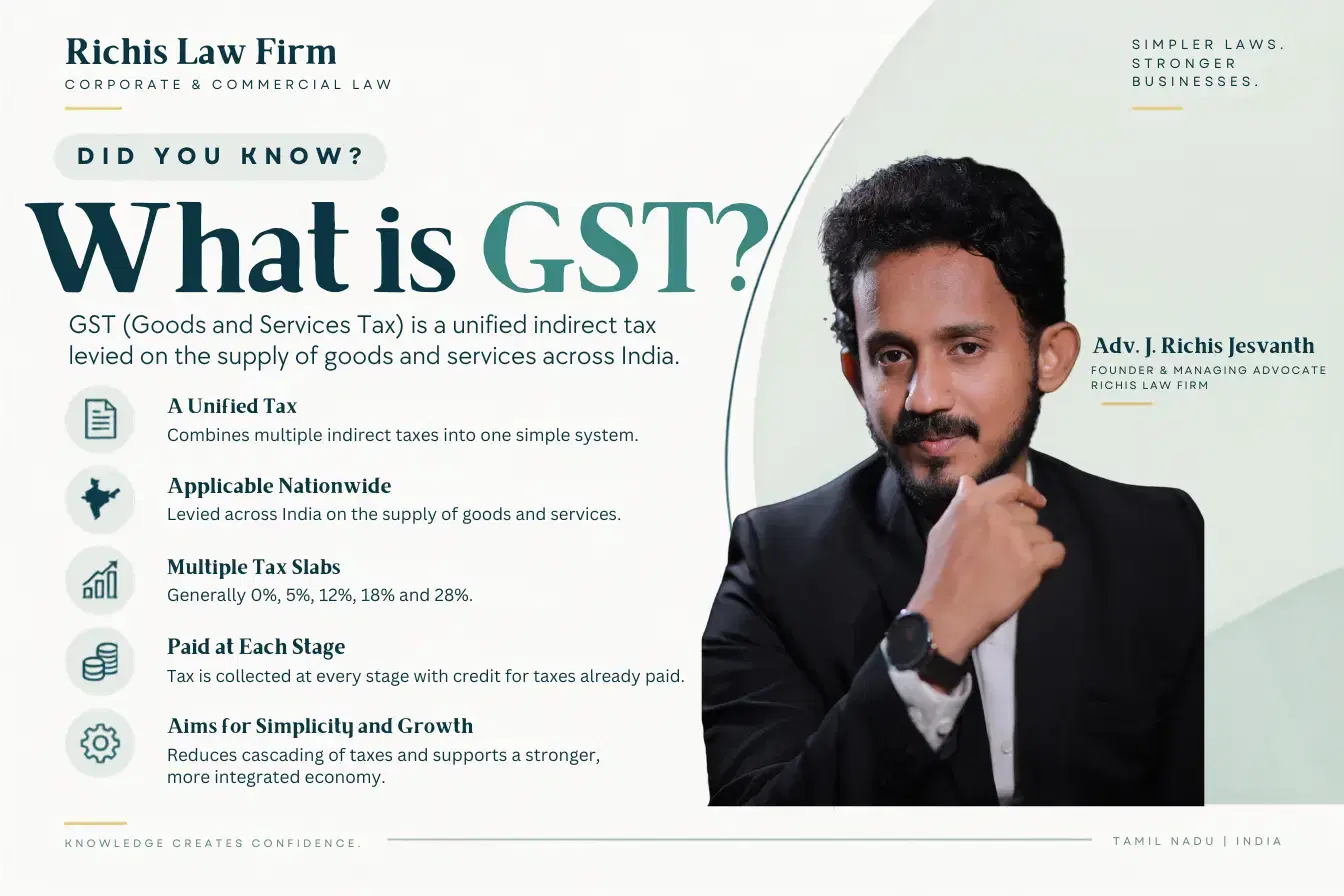
GST is a tax levied on the supply of goods and services." This is perhaps the simplest and most commonly accepted explanation of GST. However, for most businesses, this definition often gives rise to several consequential questions.
Many describe GST as a tax introduced to reduce the overall tax burden on consumers by eliminating the cascading effect of taxes. Others explain that GST is a unified, destination-based, value-added tax that replaced multiple Central and State indirect taxes. While these explanations are legally correct, they represent only one side of the GST framework.
These are the intended advantages of the GST regime. However, these advantages are realised only when businesses understand and consistently comply with the legal and procedural requirements prescribed under the law. Looking at GST solely through the lens of its benefits may create a false sense of simplicity, causing businesses to overlook the conditions that must be fulfilled, the documentation that must be maintained, and the compliance measures that must be followed to minimise scrutiny and avoid penal consequences.
Similarly, obtaining a GST registration and referring to the taxpayer guidance materials available on the GST Portal does not, by itself, equip a business with a comprehensive understanding of GST. These guides primarily explain the technical and procedural compliances expected from a registered taxpayer, such as registration, return filing, invoice generation and other statutory obligations. While they are indispensable from a compliance perspective, they cannot, by themselves, enable businesses to understand the broader legal, commercial and practical dimensions of the GST regime.
Understanding GST extends far beyond complying with procedural requirements. It requires businesses to appreciate the rationale behind the law, the conditions attached to statutory benefits, the evolving judicial interpretations, departmental practices, documentation standards and the practical implications that influence day-to-day business decisions.
Practice Perspective
"Whenever GST implications are discussed, businesses often express concern and anxiety. Yet, many continue to treat GST compliance as the sole responsibility of accountants, tax consultants or advocates, without actively understanding or monitoring their own compliance processes. In my view, this is one of the primary reasons why GST-related disputes arise. Awareness is the first step towards compliance, and compliance is the first step towards reducing unnecessary litigation."
Before GST: How India's Indirect Tax System Worked
On 1 July 2017, India witnessed one of the most significant fiscal reforms in its constitutional and economic history with the introduction of the Goods and Services Tax (GST). Nearly a decade later, GST has become an inseparable part of almost every business transaction. Whether a business manufactures goods, supplies services, imports products or expands across State boundaries, GST has become an integral component of commercial decision-making.
This naturally raises an important question.
Why was such a comprehensive tax reform considered necessary?
To answer this, it is essential to understand the indirect tax structure that existed prior to the introduction of GST.
Consider the journey of a product manufactured in one State and sold in another.
Instead of operating under a single indirect tax framework, businesses were required to navigate multiple Central, State and local levies, each administered under separate statutes, authorities and procedural requirements.
Why Was This System Considered Challenging?
The pre-GST regime was often criticised for being inconsistent with certain widely accepted principles of a sound tax system, particularly the principles of simplicity, convenience and administrative efficiency.
For many businesses, taxation was no longer merely a consequence of commercial activity; it became a determining factor in commercial decision-making.
Questions such as:
- Where should themanufacturing unit be established?
- In which State should goods be sold?
- Which transportation route should be adopted?
- Should goods move across State borders at all?
were, in many cases, influenced not only by commercial efficiency or market demand but also by the indirect tax implications associated with each decision.
Practical Challenges Under the Pre-GST Regime
Businesses commonly encountered several structural challenges.
Multiple Layers of Taxation
Central taxes, State taxes and local levies operated simultaneously, often resulting in overlapping tax jurisdictions and increased compliance obligations.
Different VAT Laws Across States
Each State had its own VAT legislation, rates, exemptions and procedural requirements. Consequently, a transaction that attracted one rate in one State could be treated differently in another, making nationwide business operations significantly more complex.
Tax on Tax (Cascading Effect)
In many situations, taxes were levied on values that already included other taxes, increasing the overall tax burden and inflating the final price paid by consumers.
Check Posts and Entry Taxes
Inter-State movement of goods frequently involved entry taxes, octroi, physical check posts and document verification. These procedural requirements often resulted in delays, increased logistics costs and disruptions to supply chains.
Multiple Regulatory Authorities
Businesses were required to interact with different tax departments, comply with separate filing systems and undergo multiple audits under different indirect tax laws.
Compliance Burden on MSMEs
For micro, small and medium enterprises, the compliance burden was particularly significant. Limited financial resources, multiple statutory obligations and the absence of a unified digital framework often made indirect tax compliance both expensive and administratively demanding.
The Need for Reform
The introduction of GST sought to address many of these structural concerns by creating a unified indirect tax framework for most goods and services.
Among its principal objectives were:
- replacing multiple indirect taxes with a more integrated tax structure;
- reducing the cascading effect of taxes through a seamless Input Tax Credit mechanism;
- facilitating smoother movement of goods across States;
- introducing technology-driven compliance through a common digital platform;
- improving transparency and data availability; and
- creating a more integrated national market.
Have the Objectives Behind GST Been Achieved? A Business Perspective
The introduction of GST was intended to address several structural inefficiencies that existed under the earlier indirect tax regime. Nearly nine years later, it is useful to examine whether those objectives have been achieved in practice. The answer is neither an absolute "yes" nor an absolute "no". While GST has undoubtedly transformed India's indirect tax landscape, it has also introduced a new set of compliance responsibilities for businesses.
The comparison below illustrates this evolution.
| Pre-GST Challenges | GST Today | Has the Objective Been Achieved? |
| Multiple indirect taxes such as Excise Duty, VAT, CST, Entry Tax and Octroi operated simultaneously. | Most indirect taxes have been subsumed into GST, creating a unified tax framework for goods and services (subject to constitutional exclusions such as petroleum products and alcoholic liquor for human consumption). | Largely Yes. The tax structure has become significantly more uniform. |
| Businesses interacted with multiple tax departments. | Businesses primarily interact through a common GST framework administered digitally, although Central and State tax authorities continue to exercise jurisdiction under the GST laws. | Substantially Yes. Administrative coordination has improved, though dual control continues in certain situations. |
| Different VAT laws existed across different States. | GST has introduced greater uniformity through common legislation, Rules and GST Council recommendations. However, State-specific administrative practices and advance rulings may still differ. | Largely Yes, with practical variations. |
| Cascading effect of taxes increased the cost of goods and services. | The Input Tax Credit mechanism seeks to minimise cascading by permitting credit of eligible taxes paid at earlier stages. However, blocked credits, procedural conditions and litigation continue to affect seamless credit. | Partially Achieved. ITC has significantly reduced cascading but remains one of the most litigated areas under GST. |
| Physical check posts, Entry Tax and Octroi frequently delayed movement of goods. | Physical border check posts have largely disappeared. E-Way Bills, RFID systems and digital verification have replaced many manual checks. | Yes. Logistics and movement of goods have become considerably more efficient. |
| Paper-based compliance and manual records dominated indirect tax administration. | Registration, return filing, notices, replies, refunds and many adjudication-related processes are conducted electronically through the GST Portal. | Significantly Achieved. GST has accelerated digital tax administration. |
| Businesses often maintained separate records for different tax laws. | Businesses now work within a unified compliance ecosystem. However, reconciliation between books of account, GSTR-1, GSTR-3B and GSTR-2B has become an ongoing responsibility. | Compliance has become more integrated, but also more data-driven. |
| Audits were conducted separately under different indirect tax statutes. | GST provides a common framework for scrutiny, audit, inspection and investigation. However, data analytics and automated mismatch detection have increased departmental scrutiny. | The number of laws has reduced, but the intensity of digital scrutiny has increased. |
| Limited data sharing made tax evasion comparatively difficult to detect. | GST relies on invoice matching, electronic trails, analytics and system-generated reports, enabling authorities to detect mismatches more efficiently. | Significantly Achieved. Transparency has improved considerably. |
| Compliance was often viewed as a periodic obligation. | GST requires continuous compliance through timely return filing, reconciliations, vendor monitoring, documentation and portal-based communication. | The nature of compliance has fundamentally changed. |
Practice Perspective
One of the most common perceptions surrounding GST is that it introduced a single indirect tax system in India. While GST has undoubtedly consolidated several major indirect taxes into a unified framework, it would be inaccurate to assume that it has become the sole indirect tax applicable in the country.
Several Central and State levies continue to exist alongside GST, including Basic Customs Duty, Anti-Dumping Duty, Safeguard Duty, Export Duty, Stamp Duty, State Excise Duty on alcoholic liquor for human consumption, Motor Vehicle Tax, Electricity Duty and certain sector-specific cesses. Consequently, businesses continue to operate within a broader indirect tax ecosystem rather than a single-tax environment.
The real achievement of GST, therefore, lies not in eliminating every indirect tax, but in substantially rationalising the taxation of goods and services that fall within its constitutional framework. The complexity has not disappeared; rather, it has shifted from managing multiple indirect tax statutes to navigating an integrated but continuously evolving GST compliance ecosystem.
Why Is Every Business Trying to Understand GST More Than Ever Before?
A decade ago, understanding indirect taxes was often considered the responsibility of accountants and tax professionals. Today, GST has become a subject of discussion not only among finance professionals but also among business owners, entrepreneurs, manufacturers, contractors, developers, traders, consultants and even start-ups.
Have a GST Question?
Have a specific GST issue or compliance question? Ask our team and provide the relevant details.
Ask a Question →The reason is simple. GST today influences far more than taxation. It influences business decisions, documentation practices, cash flow, vendor relationships, pricing strategies, digital compliance and long-term commercial sustainability.
The increasing interest in GST is therefore driven not by curiosity, but by necessity.
1. Because GST Has Become More Complex Than Businesses Initially Expected
When GST was introduced, it was widely projected as a simplified indirect tax system under the slogan "One Nation, One Tax."
While the reform undoubtedly rationalised a significant portion of India's indirect tax structure, businesses soon realised that complying with GST requires far more than understanding a single tax.
Questions such as:
• Is this transaction taxable?
• At what rate?
• Who is liable to pay tax?
• Where is the place of supply?
• When does the liability arise?
• Can Input Tax Credit be claimed?
• Should an E-Way Bill be generated?
• Is E-Invoicing applicable?
have become routine business questions.
For many businesses, understanding GST therefore became increasingly complex as commercial transactions themselves became more sophisticated.
2. Because Businesses Are Still Uncertain About What Constitutes Proper Compliance
One of the greatest practical challenges is that businesses often know what has to be filed, but remain uncertain about what has to be maintained.
Many businesses continue to ask:
- What records should be preserved?
- For how long?
- Which documents become crucial during scrutiny?
- Which reconciliations should be performed every month?
- What internal controls should be implemented?
- Who within the organisation is responsible for GST compliance?
The absence of clarity in these areas frequently results in avoidable disputes during departmental proceedings.
3. Because Documentation Has Become as Important as Tax Payment
Under GST, paying tax alone does not always conclude the compliance journey.
Businesses are expected to maintain:
- tax invoices,
- purchase records,
- sales registers,
- delivery challans,
- E-Way Bills,
- payment proofs,
- contracts,
- vendor records,
- bank statements,
- reconciliation statements,
- electronic records.
During scrutiny, these documents often become more important than verbal explanations.
A genuine transaction unsupported by proper documentation may still result in prolonged litigation.
4. Because GST Has Significantly Expanded Digital Supervision
One of the most remarkable changes introduced by GST is the shift from paper-based verification to technology-driven administration. Today, every invoice uploaded, every return filed, every Input Tax Credit claimed and every mismatch generated contributes to the taxpayer's digital compliance profile.
The Department increasingly relies upon:
- portal-based reconciliations,
- invoice matching,
- electronic trails,
- risk parameters,
- system-generated reports,
- data analytics,
rather than isolated physical inspections. Businesses therefore realise that GST compliance extends beyond accounting entries to maintaining a consistent digital footprint.
5. Because the Cost of Non-Compliance Often Exceeds the Cost of Compliance
Many businesses perceive compliance expenditure as an avoidable cost.
However, delayed compliance may subsequently result in:
- interest,
- penalties,
- blocked Input Tax Credit,
- recovery proceedings,
- bank attachment,
- mandatory pre-deposit before appeals,
- litigation expenses,
- working capital constraints.
The financial consequences of non-compliance frequently exceed the expenditure that would have been incurred by establishing proper compliance systems at the outset.
Practice Perspective
One concern repeatedly encountered in practice is that businesses often hesitate to invest in preventive compliance but later incur substantially higher costs in defending assessments, appeals and recovery proceedings. Compliance is generally a planned business expense; litigation is an unplanned financial burden that can affect profitability for several years.
6. Because Businesses Want to Understand the Work Performed by Their Professionals
GST has significantly increased dependence upon accountants, auditors, tax consultants and advocates.
However, businesses increasingly recognise that professional assistance cannot substitute business awareness.
A business owner who possesses a basic understanding of GST is better equipped to:
- evaluate professional advice,
- identify business risks,
- identify business risks,
- understand notices,
- ask informed questions,
- and establish internal accountability.
GST awareness therefore enables businesses to become informed decision-makers rather than passive recipients of professional services.
7. Because Every Business Sector Faces Unique GST Challenges
Although GST is a common tax framework, its practical implications differ across industries.
For example,
- A small manufacturer may now compete more directly with larger organised manufacturers after the removal of earlier tax structures and exemptions that influenced pricing.
- A real estate developer may encounter commercial negotiations where purchasers resist paying GST separately, affecting pricing strategies and Input Tax Credit planning.
- Agricultural processing units and agri-businesses increasingly operate within a technology-driven compliance environment that demands greater digital readiness.
- Exporters, contractors, consultants, healthcare providers, educational institutions and e-commerce businesses each encounter distinct GST issues that cannot be understood through general principles alone.
Consequently, businesses seek GST knowledge that is relevant to their own industry.
8. Because GST Is Built Upon Fundamental Concepts That Every Business Must Understand
Many disputes arise not because businesses deliberately evade tax, but because they fail to understand the foundational principles governing GST.
Questions relating to:
whether a transaction constitutes a supply,
- the time of supply,
- the place of supply,
- classification,
- valuation,
- the person liable to pay tax,
and eligibility to claim Input Tax Credit,
determine the taxability of almost every commercial transaction.
Without understanding these foundational concepts, businesses often find it difficult to appreciate why tax has become payable or why a benefit has been denied.
9. Because Many Beneficial Provisions Remain Underutilised
Businesses often focus on tax liability while overlooking statutory benefits designed to reduce compliance burdens.
For example,
the Quarterly Return Monthly Payment (QRMP) Scheme, composition levy, Input Tax Credit optimisation, electronic cash and credit ledger management, various procedural relaxations are frequently underutilised due to lack of awareness.
A better understanding of GST therefore enables businesses not only to comply with the law but also to legitimately benefit from the statutory framework.
10. Because GST Has Created a Culture of Continuous Compliance
Unlike many other laws that require attention only when a dispute arises, GST operates throughout the life cycle of a business.
Every invoice, every purchase, every sale, every payment, every return,every reconciliation and every departmental communication contributes to a business's overall compliance profile.
GST therefore demands continuous attention rather than occasional compliance.
11. Because GST Is Ultimately About Financial Sustainability
The objective of understanding GST is not merely to avoid notices or penalties.
It is to enable businesses to:
- protect cash flow,
- reduce avoidable tax costs,
- maintain investor confidence,
- improve financial discipline,
- support sustainable business growth,
and minimise long-term litigation.
Viewed from this perspective, GST is no longer simply a tax law; it is an integral part of responsible business management.
Reality Check
Many businesses fear GST because they perceive it as unpredictable. In practice, the fear often stems not from the law itself but from a lack of visibility into their own compliance processes.
Notices rarely arise "out of nowhere." More often, they are triggered by statutory defaults, data mismatches, incomplete documentation or procedural non-compliance. Businesses that understand how the GST ecosystem functions are generally better positioned to anticipate risks, respond effectively and avoid unnecessary litigation.
Understanding GST Beyond the Bare Act
One of the most common misconceptions among businesses is that GST can be fully understood by reading the Central Goods and Services Tax Act, 2017 or the corresponding State GST Act. While reading the Bare Act is undoubtedly the starting point, it is by no means the end of understanding GST.
Today, legal language is more accessible than ever before. With the assistance of commentaries, digital resources and professional guidance, many educated individuals can read and broadly understand statutory provisions. However, the ability to read a statute should not be mistaken for the ability to understand how the law operates in practice.
Even if one carefully studies all 21 Chapters of the CGST Act, one primarily understands the statutory framework that governs the levy, collection and administration of GST. The Act explains concepts such as taxable supply, registration, Input Tax Credit, returns, assessment, inspection, search, seizure, recovery, appeals and offences. These provisions define the legal rights, obligations and enforcement mechanisms recognised by law.
However, the Bare Act alone does not answer many of the practical questions that businesses encounter on a daily basis.
For example,
- What internal documents should be maintained to substantiate a transaction?
- What financial records are likely to be examined during departmental scrutiny?
- How should vendor due diligence be carried out before entering into commercial transactions?
- What documentary evidence should be preserved to support an Input Tax Credit claim?
- How should contracts be drafted to avoid future GST disputes?
- How should businesses establish internal compliance systems that reduce regulatory risk?
The answers to these questions are rarely found in the Bare Act alone.
In practice, understanding GST extends far beyond statutory interpretation. It requires businesses to appreciate the interaction between legal provisions, commercial decisions and financial discipline.
A GST-compliant business is therefore not merely one that files returns. It is one that establishes systems capable of supporting every figure reported in those returns through proper documentation, financial records and internal controls.
Practice Perspective
One of the most significant misconceptions encountered in practice is that GST scrutiny primarily focuses on whether tax has been paid. In reality, scrutiny frequently extends much further. Tax authorities often seek to verify whether every taxable transaction has been correctly identified, properly recorded,adequately documented, accurately reported through the GST Portal and supported by reliable financial records. From a practical perspective, businesses that consistently identify taxable transactions, maintain complete documentation, report them accurately through statutory returns and discharge the applicable tax within the prescribed timelines are generally better positioned to respond to departmental scrutiny than businesses that view GST merely as a return-filing exercise.
How Should Businesses Actually Understand GST?
Many businesses begin their GST journey with a common objective:
"I want to understand the entire GST law."
While this is an admirable goal, it is neither practical nor necessary for most business owners.
GST is one of the most dynamic areas of Indian tax law. The legal framework continues to evolve through statutory amendments, Rules, Notifications, Circulars, judicial pronouncements and recommendations of the GST Council. Attempting to master every aspect of the legislation is therefore neither feasible nor commercially efficient for a business owner.
Instead of attempting to become an expert in GST law, businesses should aim to become GST-compliant.
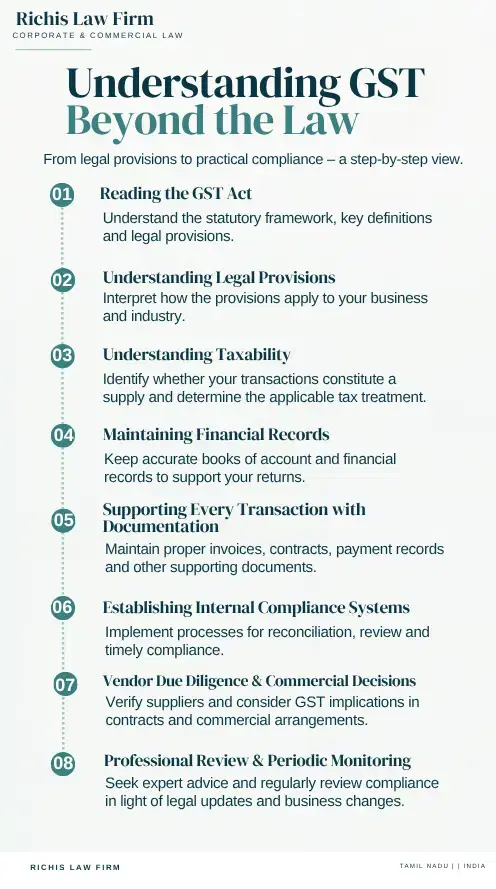
The objective is not to memorise every provision of the Act but to establish a compliance framework suited to the nature, size and operations of the business.
A business should therefore focus on understanding the practical aspects of compliance that directly influence its day-to-day operations.
What Should Every Business Focus On?
A GST-compliant business should strive to:
- Understand which statutory registrations and returns are applicable.
- Maintain complete books of account and supporting documents.
- Preserve invoices, contracts, payment records and other financial evidence.
- Ensure that every return filed accurately reflects the underlying financial records.
- Exercise due diligence while selecting suppliers, particularly where Input Tax Credit is involved.
- Establish internal systems for verifying invoices, reconciliations and statutory filings.
- Understand the figures reported by accountants and tax professionals rather than accepting them without review.
- Monitor statutory deadlines for return filing, tax payment and departmental responses.
- Maintain access to GST Portal credentials and understand how to view notices, orders and communications.
- Seek timely professional assistance upon receiving notices rather than waiting for recovery proceedings to commence.
GST Compliance: A Practical Checklist
- Understand the GST framework applicable to your business
- Identify the correct tax treatment for each transaction
- Maintain complete and accurate financial and GST records
- Preserve invoices, purchase records, contracts and supporting documents
- Ensure every transaction is properly documented and reported
- Reconcile GST records with your underlying financial records
- Monitor GST portal communications, notices and compliance requirements
- Review Input Tax Credit eligibility and supporting documentation
- Maintain internal systems for timely GST compliance and review
- Seek professional assistance when GST issues require legal or technical interpretation.
Reality Check
GST compliance is not measured by how many provisions of the Act a business owner can quote. It is measured by whether the business can substantiate every taxable transaction through proper records, documentation and timely statutory compliance.
Businesses therefore need not become GST experts; they must become disciplined custodians of their own financial information.
Still Have a Question About GST?
Every business is different. If you have a GST question relating to registration, Input Tax Credit, returns, documentation, notices or compliance, you can ask our team.
Have a specific issue? Ask your question online and provide the relevant details.
Ask a Question →What Businesses Should Remember
- GST affects more than tax payment—it influences documentation, pricing and business decisions.
- Accurate records and documentation are central to GST compliance.
- Input Tax Credit is subject to statutory conditions and proper records.
- Digital reporting makes accuracy and reconciliation increasingly important.
- Businesses need not become GST experts; they need a disciplined compliance system.
Conclusion: Understanding GST Is About Understanding Your Business
For many businesses, GST is viewed as another statutory obligation that begins with registration and ends with filing returns. In reality, GST extends far beyond periodic compliance. It influences commercial negotiations, pricing strategies, vendor selection, documentation practices, financial reporting and the overall manner in which a business operates.
Throughout this article, we have seen that understanding GST is not merely about learning statutory provisions. It is about understanding the commercial consequences of every business transaction. The CGST Act and the respective State GST Acts provide the legal framework, but practical compliance requires businesses to maintain disciplined documentation, establish effective internal controls, monitor statutory developments and respond promptly to departmental communications.
Businesses need not aspire to become tax experts or memorise every provision of the law. Instead, they should strive to build systems that ensure consistent compliance and enable them to support every return filed with accurate financial records and documentary evidence.
Ultimately, GST should not be viewed merely as a tax imposed on business transactions. It should be viewed as a governance framework that encourages transparency, accountability and financial discipline within an organisation. Businesses that proactively understand this framework are generally better positioned to minimise disputes, protect cash flow and make informed commercial decisions in an increasingly data-driven regulatory environment.
Continue Reading
Frequently Asked Questions
What is GST?
GST, or Goods and Services Tax, is a destination-based indirect tax levied on the supply of goods and services, subject to the applicable provisions, exemptions and statutory conditions under the GST framework.
Does GST apply to all businesses in Tamil Nadu?
No. GST applicability depends on factors such as the nature of the business, taxable supplies, turnover, registration requirements and specific statutory provisions. Certain activities and categories of persons may be subject to specific rules, exemptions or registration requirements.
What is the difference between CGST, SGST and IGST?
CGST is the Central Goods and Services Tax, while SGST is the State Goods and Services Tax. For an intra-State taxable supply, CGST and SGST are generally levied together. IGST, or Integrated Goods and Services Tax, generally applies to inter-State supplies and certain other transactions covered by the IGST framework.
Why was GST introduced in India?
GST was introduced to substantially rationalise India's indirect tax structure, reduce cascading, facilitate a more integrated national market and move towards technology-driven tax administration.
Is GST the only indirect tax applicable in Tamil Nadu?
No. GST has subsumed several major Central and State indirect taxes, but various taxes and levies continue to operate outside the GST framework, depending on their constitutional and statutory treatment.
What is Input Tax Credit under GST?
Input Tax Credit (ITC) generally enables an eligible registered person to claim credit for qualifying GST paid on inward supplies, subject to the statutory conditions, restrictions and documentation requirements prescribed under the GST law.
How can businesses in Tamil Nadu improve their GST compliance?
Businesses should establish appropriate registration and filing processes, maintain complete records, reconcile their books with GST returns and relevant statements, monitor statutory deadlines, preserve supporting documentation and obtain professional advice where the transaction or compliance issue warrants it.
Disclaimer
This article is for general information only and does not constitute legal advice or create an advocate-client relationship. Statutes, rules, rates and compliance requirements change over time and vary by circumstance.
RICHIS LAW FIRM — Strategic Business Legal Advisors.
Safeguarding business interests and enabling growth across Tamil Nadu.
Richis Jesvanth J
B.Com., LL.B., LL.M. (Corporate & Commercial Law), CS Finalist
Practising in Company Law
Pavyaa Angelina K
B.B.A., LL.B.
Practising in Taxation Law